
Newsletter Subscription
Enter your information below and subscribe to our newsletter

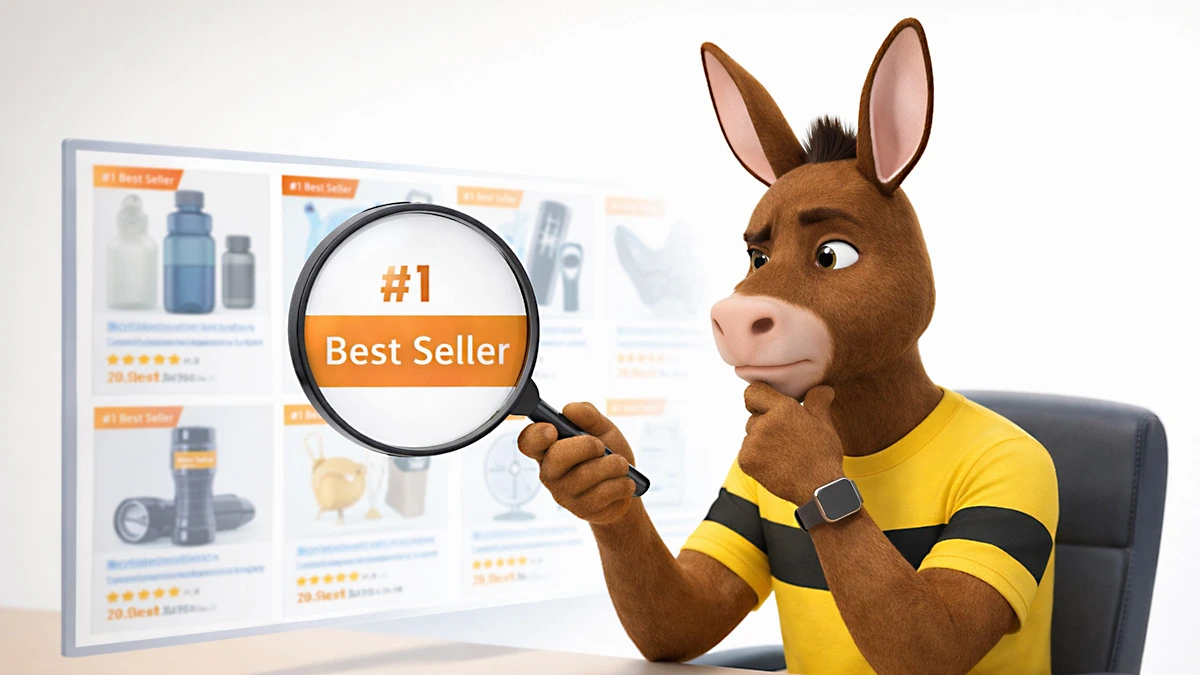
Amazon best sellers are often assumed to be the best products available — but the truth behind the badge is more complicated. Walk into any Amazon category, and you’ll see it everywhere: a small orange tag that says “#1 Best Seller.” To many shoppers, that badge feels like a shortcut. If thousands of people bought it, it must be good, right?
Not necessarily. The truth is that Amazon’s Best Seller badge tells you what’s selling quickly in a specific moment, not what’s actually the best product.
Once you understand how the badge works, you’ll start seeing it very differently.
This website contains affiliate links. As an Amazon Associate, I earn from qualifying purchases. The content on this website was created with the help of AI.
Amazon calculates the badge using a metric called Best Seller Rank (BSR). BSR tracks recent sales velocity within a specific product category.
In simple terms:
The product selling the fastest right now gets the badge. That means the badge reflects momentum rather than long-term quality.
A product can become a Best Seller because of:
In some cases, the product may truly be excellent. But often, it’s simply the item currently getting the most attention.
Another surprising detail: Best Seller badges are awarded within specific categories.
For example, a product might be:
#1 Best Seller in “Garlic Presses”
But that doesn’t mean it’s the best kitchen tool overall. It only means it’s selling quickly in that particular niche.
Some sellers take advantage of this by listing products in very narrow subcategories with lower competition.
That’s how you sometimes see items labeled:
Technically true. But not necessarily meaningful.
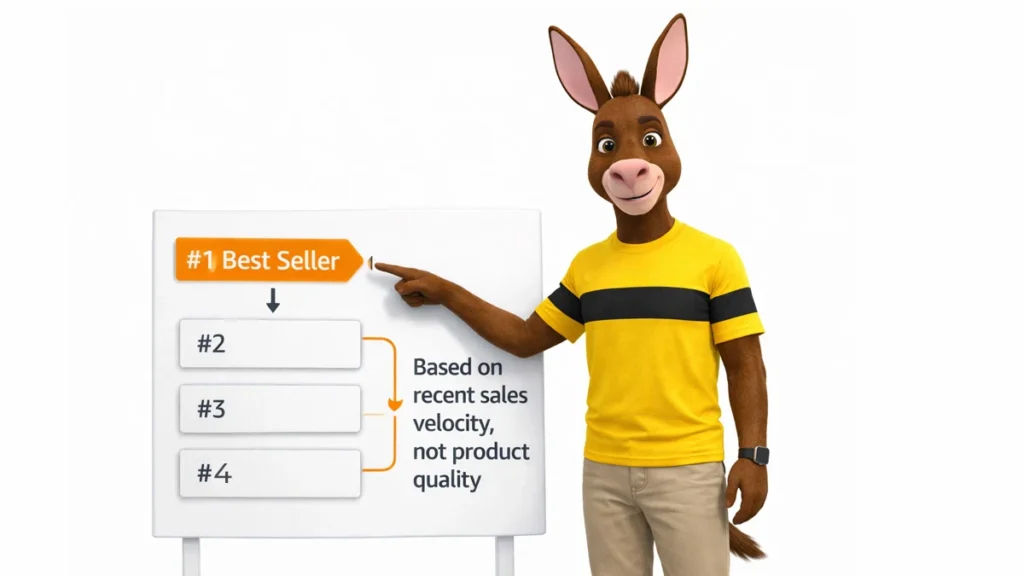
Unlike product reviews, Best Seller Rank updates constantly. A product that spikes in sales for a few hours can suddenly become a Best Seller, then it may disappear from the list just as quickly.
This is why you’ll often see the badge rotate among several competing products in the same category.
In other words:
The badge is a snapshot of what’s hot, not a permanent award.
If Gregory the donkey were shopping online, he wouldn’t panic-buy the first product wearing a shiny badge.
He’d ask a few calm questions first:
Gregory believes good shopping is less about speed and more about quiet investigation.
The Best Seller badge is simply one clue in a much larger puzzle.
If you want to find products that truly perform well, pay attention to these signals instead.
Look for products that have accumulated thousands of reviews over multiple years rather than a sudden spike. Longevity is often a sign of reliability.
The most helpful reviews are rarely five-star celebrations. They’re usually balanced, thoughtful critiques that describe how the product performs in real life.
Products recommended by credible sources — journalists, professionals, or well-known reviewers — often prove more reliable than popularity driven by algorithms.
Companies confident in their products usually offer strong guarantees. A vague or difficult return process can be a warning sign.
To be fair, the badge isn’t meaningless.
It can be helpful for discovering:
But Amazon best sellers should be treated as a starting point for research, not the final decision.
The internet rewards speed, but smart shoppers reward patience.
The best product isn’t always the one that’s trending today. It’s the one that still performs well months and years after the hype fades. And that’s exactly the kind of product Gregory prefers to recommend.
What does the Amazon Best Sellers badge actually mean?
The badge indicates the product is currently selling faster than other items in its category, as measured by Amazon’s Best Seller Rank (BSR), which tracks recent sales velocity.
Does “Best Seller” mean the product is the best quality?
No. The badge reflects sales momentum, not product quality, durability, or long-term customer satisfaction.
How often does the Amazon Best Seller badge change?
It can change frequently—sometimes within hours—because rankings update based on recent sales.
Can sellers manipulate Best Seller rankings?
While Amazon monitors manipulation, tactics like aggressive discounts, ad campaigns, and viral promotion can temporarily boost sales and rankings.
Should shoppers trust the Best Seller badge?
It’s a useful signal of popularity, but should be combined with review analysis, warranty policies, and independent recommendations.
According to Amazon’s own documentation on Best Sellers Rank, the ranking reflects how well a product is selling compared to other items in its category and is updated frequently based on recent sales activity.
Not sure whether Amazon Best Sellers actually deserve that badge? Ask Gregory — the Investigative Donkey is standing by to help you look past the hype before you click Add to Cart.