
Newsletter Subscription
Enter your information below and subscribe to our newsletter

Nitric oxide is one of the most important signaling molecules in the human body. Most people have never heard of it. Their cardiovascular system has.
In 1998, three scientists won the Nobel Prize in Physiology or Medicine for discovering that a simple gas, just one nitrogen atom and one oxygen atom, was quietly running some of the most important operations in the human body. The Nobel committee called nitric oxide “the most important molecule in the body.” That’s a big claim. It turns out it’s earned.
Nitric oxide (NO) regulates blood pressure, delivers oxygen to your tissues, helps your immune system fight off pathogens, and even modulates how your brain sends signals. And here’s the part most people don’t know: your body’s ability to produce it declines with age, starting as early as your 30s. Poor diet, chronic stress, and a sedentary lifestyle accelerate the drop.
The good news is that nitric oxide production is genuinely responsive to lifestyle. What you eat, how you breathe, how often you move, and even how much sun you get all play a measurable role. Supplements can help too, but they’re the last piece of the puzzle, not the first.
This guide covers the whole picture, in order of what actually matters.
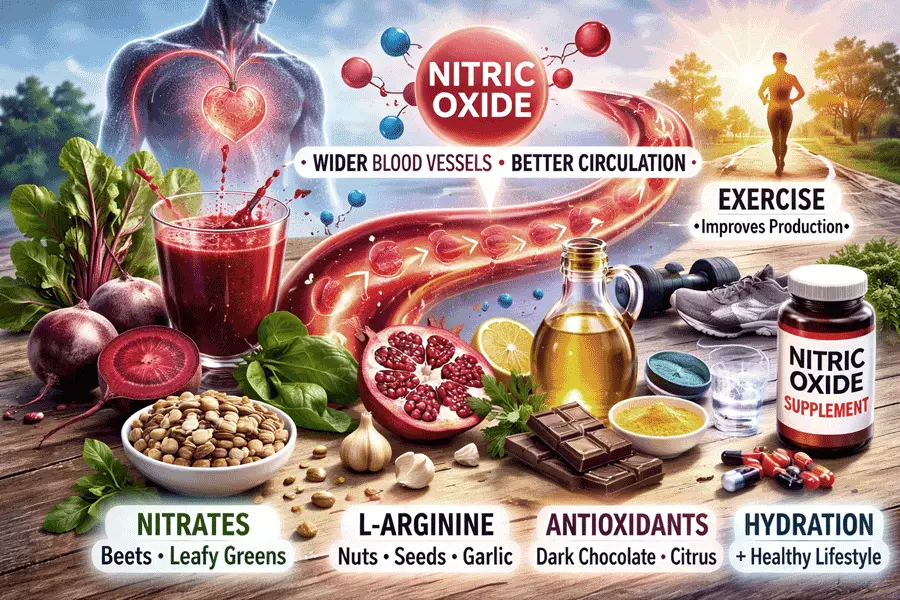
Nitric oxide is produced primarily in the endothelium, the thin layer of cells that lines every blood vessel in your body. Its primary job is to signal the smooth muscle surrounding those vessels to relax, thereby widening them. That widening, called vasodilation, is how your body regulates blood pressure and ensures that oxygen and nutrients reach every organ, muscle, and cell that needs them.
But NO is more than a vascular signal. It also:
NO is considered the body’s only known “healthy free radical,” a reactive molecule that is genuinely beneficial in normal physiological amounts, unlike the oxidative free radicals that damage cells. It’s unstable by nature, lasting only a few seconds in the bloodstream before breaking down, which is why sustained production matters more than any single spike.
Low nitric oxide is not a fringe concern. A significant portion of adults are thought to have suboptimal levels, often without obvious symptoms until something more serious develops.
When NO production is impaired, the condition is called endothelial dysfunction — the blood vessel lining stops working as it should. Over time, this contributes to:
The connection to aging is direct. As we get older, endothelial NO synthase, the enzyme that produces most of our NO, becomes less active. At the same time, a compound called ADMA (asymmetric dimethylarginine) accumulates in the body and actively blocks NO production. The result is a gradual narrowing of blood vessels and a steady increase in cardiovascular risk.
The upside: this decline is not inevitable. The factors most responsible for it, such as diet, movement, stress, and breathing habits, are all within your control.
The most reliable way to support nitric oxide production isn’t a supplement. It’s what’s already on your plate.
Certain foods are rich in dietary nitrates — compounds that your body converts to nitric oxide through a surprisingly elegant process. When you chew high-nitrate foods, friendly bacteria in your mouth convert nitrates into nitrites. Those nitrites travel to your stomach, where they are converted into nitric oxide and released into the bloodstream. The whole system depends on healthy oral bacteria, which is worth keeping in mind.
These are the foods with the most direct, well-documented impact on NO production:
Most nitric oxide articles stop at beets and leafy greens. But there are three things you probably already have in your kitchen that are worth knowing about:
Garlic — this is the best-supported of the three. Allicin, the active compound released when garlic is crushed or chopped, has robust peer-reviewed evidence supporting its ability to stimulate endothelial NO production and trigger NO-dependent vasodilation. One human study found that just 2g of fresh garlic measurably increased plasma NO concentrations within a few hours. Powdered garlic retains some activity, though less than fresh garlic, and heat and heavy processing reduce allicin content. When using powder, crushing or briefly blooming it in warm (not boiling) oil helps activate it.
Ceylon cinnamon — cinnamaldehyde, the key compound in cinnamon, has been shown to stimulate endothelial NO synthase and support vasodilation. The Ceylon variety matters here: regular cassia cinnamon contains higher levels of coumarin, which can cause liver issues at higher, regularly consumed doses. One teaspoon of Ceylon cinnamon per day is a reasonable amount. Stirring it into oatmeal, coffee, or a smoothie is the easiest way to deliver it. One note worth making: cinnamon also inhibits inflammatory NO (the iNOS pathway), which is actually a good thing. These are two different enzymes. Suppressing inflammatory NO while supporting endothelial NO is a net benefit.
Ginger — gingerols, ginger’s active compounds, have been shown to increase nitric oxide synthesis and enhance endothelial function in multiple studies. A 12-week randomized controlled trial found that supplementation with ginger powder significantly increased serum NO concentrations compared with placebo. Like cinnamon, ginger also reduces inflammatory NO via a separate pathway — the net vascular effect is positive. Fresh ginger and dried powder both retain activity, though fresh is generally more potent.
| Gregory’s Note on Raw vs. Cooked: Cooking reduces the nitrate content of vegetables, particularly boiling, which leaches nitrates into the water. Raw or lightly steamed is the better choice for maximizing NO benefits. Also: chew thoroughly. The conversion of nitrates to nitrites occurs in your mouth via oral bacteria and requires adequate contact time. Gulping down a green smoothie isn’t quite the same as eating the vegetables themselves. |
This one is counterintuitive. Antibacterial mouthwash, particularly the kind that kills all oral bacteria, disrupts the very microbes responsible for converting dietary nitrates into nitrites. Studies have found that using strong antibacterial mouthwash before meals can meaningfully reduce the NO-boosting effect of a high-nitrate diet.
This doesn’t mean skipping oral hygiene. It means being thoughtful about the timing of antibacterial rinses, and considering whether a gentler approach to oral care might serve you better overall.
Diet gets most of the attention, but some of the most reliable ways to support NO production have nothing to do with food.
Exercise is one of the most powerful triggers for endothelial NO production. When blood flow increases during physical activity, mechanical shear stress on the vessel walls stimulates the endothelium to release NO. This isn’t unique to intense training. Research shows that even 20–30 minutes of moderate aerobic activity, such as a brisk walk, a bike ride, or light cardio, reliably increases NO availability and improves how blood vessels function.
The effect appears cumulative over time: regular movement keeps the endothelium responsive and productive. A sedentary lifestyle does the opposite.
Your nasal passages and sinuses continuously produce nitric oxide, which is then delivered to your lungs and bloodstream when you inhale through your nose. Studies have measured oxygen levels about 10% higher during nasal breathing than during mouth breathing in healthy subjects, partly because of NO delivery.
Mouth breathing bypasses this entirely. It also reduces NO levels in the airways, which may impair the molecule’s antimicrobial function — nasal NO helps neutralize airborne pathogens before they reach the lungs.
The practical takeaway: make a conscious effort to breathe through your nose during rest, exercise, and sleep. If you habitually mouth-breathe at night, nasal strips can help. This is one of the lowest-effort, highest-leverage interventions on this list.
Sunlight, specifically UV-A rays, triggers the skin to release stored nitrates, which then convert to nitric oxide. Research has confirmed that sun exposure increases circulating NO through this mechanism, independent of vitamin D. The effect supports vasodilation, lowers blood pressure, and improves mood.
The threshold is modest: 10–20 minutes of direct sun exposure on the arms and legs a few times per week appears sufficient. Early morning or late afternoon sun is gentler. The usual caveats apply — this isn’t a license to skip sunscreen on prolonged outdoor exposure.
Chronic stress suppresses NO production through multiple pathways as stress hormones cause blood vessels to constrict, counteracting NO’s vasodilatory effects, and sustained oxidative stress degrades NO before it can act. Interestingly, research has found that mindfulness meditation practitioners have higher nitrate levels and lower stress markers than controls.
Slow nasal breathing, which activates the parasympathetic nervous system, also triggers NO release through the nasal pathway. Breathwork, meditation, or simply stepping away from a stressor regularly appear to support NO levels in ways that complement diet and exercise.
Nitric oxide supplements have a large and enthusiastic market. The science is more measured. Here’s an honest summary of what’s available and what the evidence actually supports.
First, an important clarification: nitric oxide supplements don’t contain nitric oxide. NO is a gas that lasts seconds in the body — you can’t bottle it. Instead, these products contain precursors and compounds that help your body produce more of its own.
This is the most evidence-backed option. L-citrulline is an amino acid that converts to L-arginine in the kidneys, which then serves as the primary substrate for NO synthesis. Citrulline is better absorbed than arginine taken directly — oral L-arginine is largely broken down in the gut before it can be used, whereas citrulline bypasses this degradation.
Doses in clinical research typically range from 3–6g per day. Look for supplements that use citrulline rather than arginine as the primary ingredient, or a combination that favors citrulline.
Beetroot supplements are the food-derived option and, when produced correctly, can meaningfully increase plasma nitrate and nitrite levels. The important caveat: the majority of beet products on the market contain little to no detectable nitrate because of how they’re processed. Look for products from reputable sources that specify nitrate content or use gentle processing methods that preserve bioavailability. Concentrated beet juice (shots) from established sports nutrition brands tend to be more reliable than generic beet powder capsules.
L-arginine is the direct precursor to NO synthesis, which makes it an obvious choice. In practice, oral L-arginine has poor bioavailability — the gut metabolizes a significant portion before it reaches circulation. It can also cause gastrointestinal discomfort at higher doses. It’s worth noting that researchers have found the amount of NO you could get from arginine supplements is often achievable through high-nitrate foods. L-arginine supplements are not recommended without a specific clinical reason, and should not be taken without consulting a doctor — particularly by anyone with cardiovascular conditions.
NO is an unstable molecule that breaks down quickly in the presence of oxidative stress. Antioxidants, particularly vitamin C and the polyphenols found in berries, dark chocolate, and green tea, help preserve NO by neutralizing the free radicals that degrade it. This is less about producing more NO and more about protecting the NO you’re already making. Getting these through food is preferable to supplementation for most people.
| Before You Supplement: Nitric oxide supplements interact with medications, particularly blood pressure drugs and nitrates used for heart conditions. People with cardiovascular disease, diabetes, or kidney issues should consult a doctor before starting any NO-related supplement. If you’re pregnant or breastfeeding, avoid them. Overall, research on supplements is mixed. For most healthy adults, the food-and-lifestyle approach produces comparable results with fewer risks and no cost. |
Gregory’s research shows nitric oxide is a genuinely important molecule, the science is solid, and the practical levers are more accessible than most people realize. The hierarchy is clear:
The supplement industry around nitric oxide is noisy. Most products make large claims on thin evidence. But the underlying biology is not hype — and the non-supplement interventions that support NO production are the same ones that support almost every other system in your body. A good diet, regular movement, quality breathing, and stress management are not flashy. They are, however, what the evidence actually supports.
That’s not a coincidence. It’s just how the body works.
This website contains affiliate links. As an Amazon Associate, I earn from qualifying purchases. The content on this website was created with the help of AI.
If you’ve already got the diet and lifestyle basics in place and want to add a supplement layer, the market is cluttered with products that promise more than the science supports. These are the categories and specific products worth considering — chosen for ingredient quality, transparency, and track record rather than marketing claims.
L-citrulline converts to L-arginine in the kidneys — the direct precursor to nitric oxide synthesis — and absorbs far more reliably than arginine taken directly. It’s the ingredient with the strongest clinical backing in this category. Look for standalone citrulline or citrulline malate (a common pairing used in sports nutrition), not blends where the dose is buried in a proprietary formula.
Thorne L-Citrulline — Thorne is one of the few supplement brands that manufactures in NSF-certified facilities and publishes third-party testing results. Their citrulline is an unflavored powder with no fillers, no proprietary blends, just the ingredient. Check it out on Amazon
NOW Sports L-Citrulline — A more budget-friendly option from a brand with a long track record and Informed Sport certification. Capsule format if you prefer not to deal with powder. Check it out on Amazon
Beetroot supplements can meaningfully raise plasma nitrate levels — but most products on the market contain little to no detectable nitrate due to processing. The key is finding a brand that maintains nitrate bioavailability and, ideally, specifies nitrate content on the label.
HumanN SuperBeets — One of the more established beetroot brands in the consumer market, with a focus on nitric oxide specifically. Uses a cold-processing method designed to preserve nitrate content. Available in powder and chew formats. Check it out on Amazon
| 🚫 What Gregory Would Skip: Generic “Nitric Oxide Booster” blends with 15–25 ingredients, no disclosed doses, and a label full of trademarked compound names. The proprietary blend problem is widespread in this category — it makes it impossible to know whether you’re getting a meaningful amount of anything. If a product won’t tell you how much L-citrulline is in a serving, that’s all you need to know. |
This article is for informational purposes only and does not constitute medical advice. Consult a qualified healthcare provider before making changes to your diet, lifestyle, or supplement regimen, particularly if you have an existing health condition or take medications.