
Newsletter Subscription
Enter your information below and subscribe to our newsletter

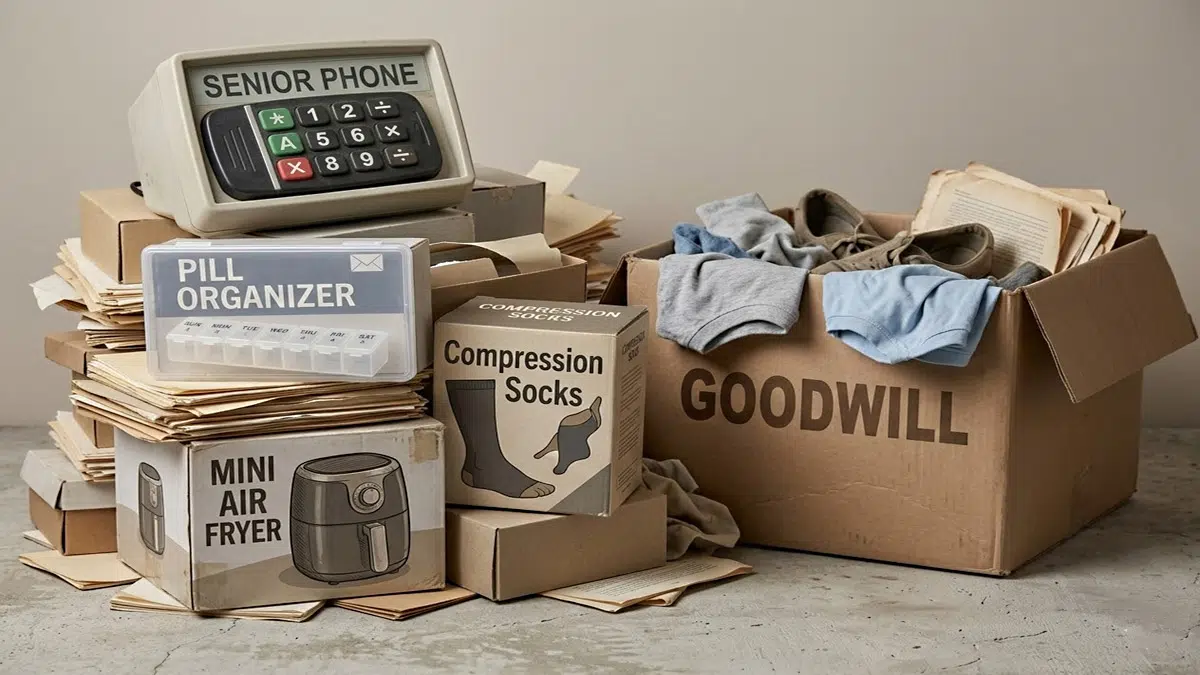
There is an entire category of gifts seniors don’t want but will never tell you about. They arrive in cheerful packaging, get received with a convincing smile, and quietly disappear into a closet, a donation bag, or the guest room shelf of politely retired objects.
Gregory investigated. The items on this list aren’t bad products — they’re wrong products, chosen with love and selected without asking. Every one of them says something the buyer didn’t intend to say. Something like: I think you’re slowing down. I think you need help. I think you can’t manage.
This is not a roast of your intentions. This is an intervention.
This website contains affiliate links. As an Amazon Associate, I earn from qualifying purchases. The content on this website was created with the help of AI.
You saw it advertised with a silver-haired couple looking delighted. Big buttons. Simple interface. Perfect, you thought. You ordered it without asking.
Your parent already has a smartphone. They’ve had one for six years. They use it to FaceTime the grandkids, check the weather, and absolutely destroy you at Wordle. You just handed them a Fisher-Price toy and called it thoughtful.
“It was sweet,” your mother will say. “I’ll keep it as a backup.”
Translation: It is in a drawer with the charger still in the box.
Why it lands wrong: It implies they can’t handle technology. It’s condescending, wrapped in foam packaging. Most adults over 65 are perfectly competent smartphone users. They occasionally need someone to show them how to turn off the flashlight, not a new phone entirely.
Gregory’s verdict: Skip it unless they specifically asked for it. If they’re genuinely struggling with their current phone, sit down with them and walk through the settings. Your time is the gift, not a device.
It has seven compartments, four alarms, a digital clock, a humidity indicator, and enough buttons to operate a small aircraft. You thought it would help your dad stay on top of his medication.
Your dad has been taking the same three pills at the same time every morning for nine years. He remembers. He has a system. What he doesn’t have is any memory of asking you to fix it.
“This is very… thorough,” he will say, examining the fourteen-page instruction booklet.
Why it lands wrong: An unsolicited pill organizer signals that you think they’re losing it — even when they’re not. Medication management is deeply personal. Receiving one you didn’t request reads as “I don’t trust you” in plastic form.
Better alternative: If there’s a genuine concern about medication management, have an honest conversation first. If they’re open to help, a simple weekly pill tray — not the one with the GPS tracker and the app — is less presumptuous and actually more practical.
You read that compression socks improve circulation. You ordered a twelve-pack in beige and navy. You shipped them with a note about the health benefits.
Your mother does not have circulation issues. She plays pickleball three times a week. You have now given her twelve pairs of socks belonging to a different person and, in writing, implied that her legs might be failing.
She will wear one pair out of kindness. The other eleven will join the pill organizer in the guest room closet.
Why it lands wrong: Medical-adjacent gifts sent without a conversation carry an unspoken message: I’m worried about your body. Even when that worry is genuine, receiving compression socks unprompted feels less like a gift and more like a diagnosis.
Gifts seniors don’t want often fall into this category — practical, well-intentioned, and quietly devastating to receive.

You installed it over Thanksgiving. You showed them how to ask about the weather. You left feeling like a hero.
Three weeks later, your father called to ask why a small cylinder was talking to him during the news. He’d said a word that rhymed with Alexa during a crossword. She responded. He was startled. He has unplugged her and placed a decorative gourd on top of her as a warning to others.
Why it lands wrong: Smart home devices require a mental model that takes real time to build. Dropping one into someone’s home without sustained setup support doesn’t create convenience — it creates a confused appliance that occasionally speaks.
Better alternative: If they’re genuinely interested, install it together and spend real time — not twenty minutes before you leave for the airport — showing them how it works. The gift isn’t the device. It’s the patient setup and the follow-up calls.
It arrived in a box that took up half the entryway. Six bath mats. Multiple sizes. Two colors. Enough non-slip surface area to carpet a studio apartment.
Your parents’ bathroom already has a bath mat. They chose it. They like it. You have now implied that their existing mat is insufficient and their bathroom is a fall hazard, which is a form of home criticism delivered in the guise of safety.
Your mother will keep one. The remaining five will constitute a mat inventory nobody asked for.
Why it lands wrong: Safety gifts sent without conversation carry an implicit message of “I’m scared you’re going to fall,” which translates to “I think you’re fragile.” Even when the concern is valid, the delivery matters enormously.
Gregory’s verdict: If fall prevention is a real concern worth acting on, have that conversation directly. Ask what would make them feel safer at home. They might want a grab bar, but they’d rather choose it themselves.
You read the reviews. 4.7 stars. Life-changing. You imagined your mother discovering a new passion for crispy vegetables in her golden years.
Your mother has cooked on the same stovetop for thirty-five years. She has mastered it. She has honed her preferences, rhythms, and techniques over decades. You have placed a large plastic machine on her counter that requires a manual, takes up significant space, and implies her existing cooking methods are somehow lacking.
The air fryer will produce exactly three batches of frozen fries before being relocated to the basement to save counter space.
Why it lands wrong: Kitchen appliances are deeply personal. Supplementing someone’s established cooking setup without being asked isn’t about them. It’s about what you think they should want.
Better alternative: If they’ve actually expressed interest in air frying, the Instant Vortex Mini 2-Quart is the one to get. Single dial, compact enough not to colonize the counter, and simple enough that the manual stays in the drawer where it belongs. If they cook for two and have counter space, the Dash Tasti-Crisp 6-Quart is worth a look — adjustable temperature dial, auto-shutoff, nonstick basket, and none of the unnecessary complexity. Just confirm they actually want one before it shows up on the doorstep.
Maybe it was a cane. Maybe a reaching tool. Maybe a jar opener with a handle the size of a small baseball bat. Whatever it was, you ordered it based on something you noticed at Christmas and interpreted as a permanent condition.
Your father pulled a muscle raking leaves in October. He is fine now. You have sent him a grab-and-reach tool that, when placed visibly in his kitchen, will serve as a daily reminder that his child thinks he is declining.
Why it lands wrong: Mobility aids touch on identity and independence in ways few other products do. Receiving one unsolicited — especially before it’s genuinely needed — can feel like a preview of a future they’re not ready to acknowledge.
Gregory’s verdict: This is a conversation to have, not a package to ship. Ask. Listen. Let them lead. Timing matters more than the product itself.
Three months of a meal kit service. A quarterly book box. A monthly snack delivery curated for active seniors. You set it up, entered your card, and sent a cheerful note about how exciting it would be.
What you didn’t account for: your parents already have a grocery routine. They have preferred snacks. They do not need pre-portioned meals arriving in insulated packaging that takes twelve minutes to disassemble. And now they feel guilty not using it — because you paid for it — and mildly stressed by boxes accumulating in the entryway.
Your mother will dutifully make two meal kits. They will be fine. She will quietly let the subscription lapse without mentioning it.
Why it lands wrong: Subscriptions introduce ongoing obligations and disrupt existing routines. The ones marketed to seniors often carry an implicit message about what seniors supposedly need, which your parents may not identify with at all.
Better alternative: If you want to give an experience, give it once. A single thoughtful meal delivery on a specific occasion is infinitely better than an ongoing subscription that they have to manage.
The answer, after Gregory’s extensive research, is embarrassingly simple: ask. Not “What do you need?” — that question invites a polite lie. Ask what they’ve been wanting, what they keep meaning to replace, and what caught their attention recently. Ask about the thing they mentioned once that you half-remember.
The gifts that land are almost never chosen from a listicle. They’re the ones that say: I was paying attention to you specifically.
And if you must shop from a list, shop for what they’ve actually told you they want, not what an algorithm, a well-meaning article, or a guilt-fueled 2 am browsing session has decided they need.
Mostly anxiety. When adult children feel concern about an aging parent but don’t know how to have a direct conversation about it, they convert that worry into a purchase. It feels productive. It feels caring. It is, unfortunately, often more about managing their own feelings than meeting a real need.
Not inherently. A good pill organizer, a quality bath mat, or an air fryer are all fine products. The problem isn’t the product, it’s the assumption that you know what someone needs without asking. Context and conversation turn an awkward gift into a genuinely appreciated one.
Then the conversation about that is more important than anything you could buy. Many seniors are reluctant to accept help because of how it’s offered, not because they don’t need it. Approaching the topic with curiosity rather than a cart full of safety equipment makes a significant difference.
Time, honestly. A visit they didn’t have to ask for. A phone call that wasn’t prompted by a holiday. Help with something specific they’ve mentioned. And if it has to be a physical object — let them pick it, or at minimum, ask first. The gifts seniors don’t want and the gifts they love are often separated by one simple question.
Gregory’s position on surprise gifts for adults over 60: the surprise isn’t the point. The point is giving something they’ll genuinely use. A casual conversation — “I’ve been thinking about getting you something, is there anything you’ve been wanting?” — is not gift-ruining. It is gift-saving.
Gregory the Investigative Donkey researches products so you don’t have to, and occasionally so your parents don’t have to smile politely at something they’ll donate before spring. No fluff. No regret.
Still not sure what gifts seniors don’t want versus what your parent might actually appreciate? Ask Gregory — the Investigative Donkey is standing by to help you think it through before you click Add to Cart on something that ends up in a donation bin by February.