
Newsletter Subscription
Enter your information below and subscribe to our newsletter
Enter your information below and subscribe to our newsletter
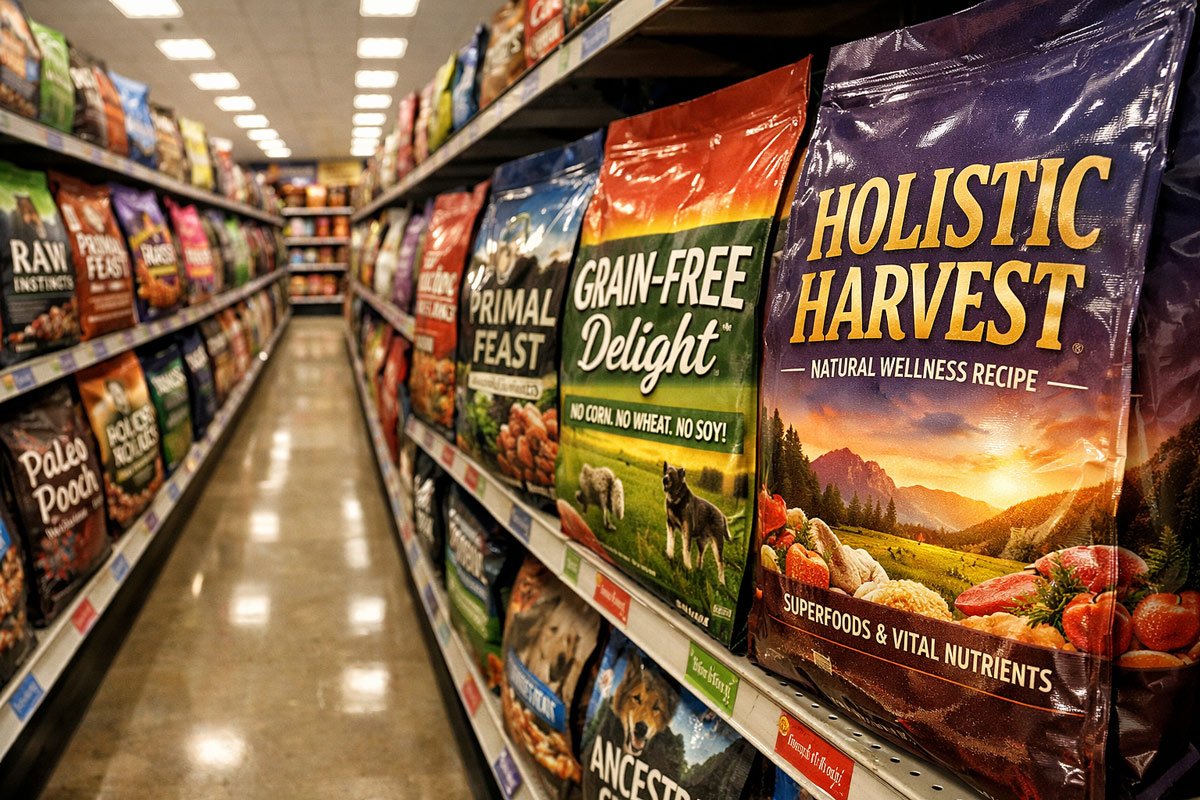
The dog food marketing scam is one of the most effective cons in retail. It works because it targets people who genuinely love their animals and because the words doing the deceiving sound exactly like they should mean something.
Gregory has strong feelings about this. Specifically, animals cannot read labels. They cannot be manipulated by packaging copy. They cannot be impressed by the word “holistic” printed in a tasteful serif font next to a photo of a golden retriever bounding through a sun-drenched meadow. Their owners, however, can. And are. Every single day.
The dog food marketing scam doesn’t rely on outright lies. It relies on something more sophisticated: words that are either completely unregulated, technically meaningless, or defined so loosely that nearly any product qualifies. The result is a $50 billion industry where “premium” dog food is often nutritionally identical to the $1.29 can next to it on the shelf.
This article decodes six of the most common buzzwords on dog food packaging — what they legally mean, what they actually mean, and what you should look for instead.
Gregory’s Take: I have a dog. I love my dog. I also refuse to pay a $40 markup for the word “holistic” printed on a bag. Let’s talk about what’s actually going on here.
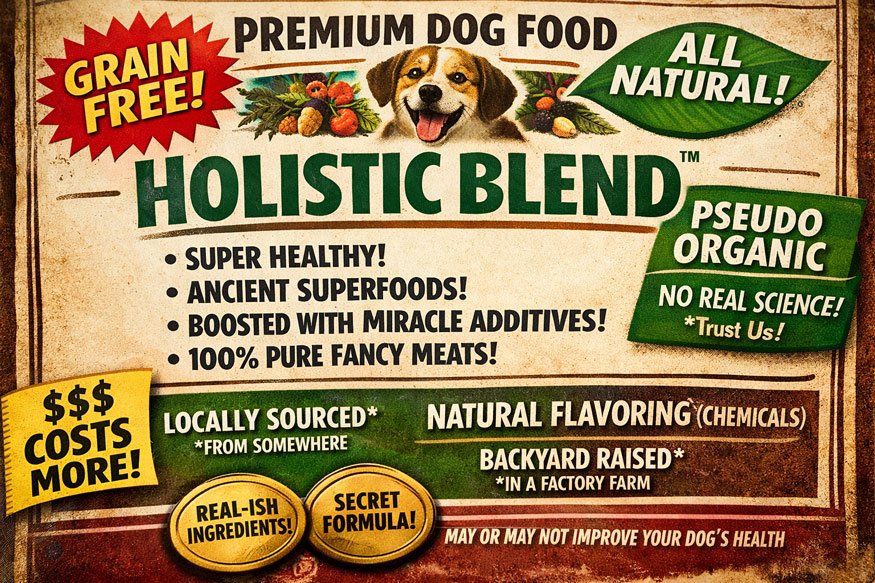
The dog food marketing scam operates on a simple principle: in the United States, the FDA regulates what goes into pet food, but it does not regulate most of the marketing language on the packaging. That gap — between what’s in the bag and what’s printed on it — is where the industry lives.
The Association of American Feed Control Officials (AAFCO) establishes nutritional standards for pet food and defines several terms. But AAFCO has no enforcement power. It publishes guidelines. Whether manufacturers follow them — and whether anyone checks — is another matter entirely.
What this means in practice: a manufacturer can call their product “super-premium ancestral holistic natural grain-free” dog food and face zero regulatory consequence, because most of those words mean nothing to any governing body. They mean everything to the consumer standing in the pet store aisle, trying to do right by their dog.
Gregory’s Take: The dog food marketing scam isn’t illegal. That’s what makes it so effective. It’s a perfectly legal exploitation of the gap between what words sound like and what they’re required to mean.
What it sounds like: A healthier, more natural diet that eliminates unnecessary carbohydrates and mirrors what dogs would eat in the wild.
What it actually means: The grains (corn, rice, wheat, barley) have been replaced with other carbohydrates — typically potatoes, peas, lentils, or tapioca. The carbohydrates are still there. You’re just paying more for different ones.
The added concern: In 2018, the FDA began investigating a potential link between grain-free diets and dilated cardiomyopathy (DCM) — a serious heart condition — in dogs. The investigation is ongoing, and causation has not been established, but the American Veterinary Medical Association recommends consulting your vet before choosing a grain-free diet. This is a detail that grain-free marketing does not mention.
Who should actually eat grain-free: Dogs with a confirmed grain allergy, diagnosed by a veterinarian. According to veterinary research, this is a very small percentage of dogs. True grain allergies are rare. Marketing departments don’t mention that either.
Gregory’s Take: The grain-free premium is largely a marketing invention built on the (incorrect) assumption that grains are bad for dogs. Most dogs digest grains just fine. Your wallet, however, may not survive the grain-free aisle.
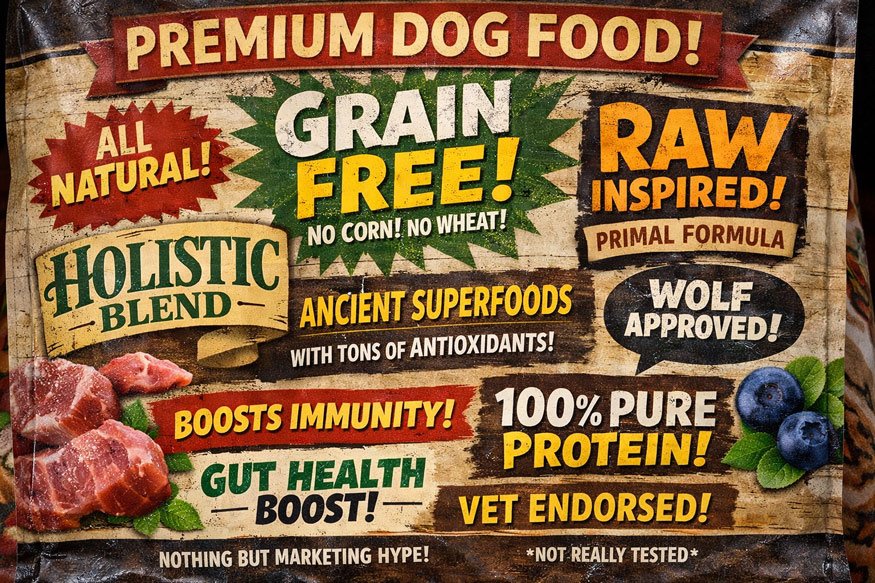
What it sounds like: A thoughtfully formulated diet that considers the whole animal — body, mind, and nutritional balance.
What it actually means: Nothing. Legally, definitively, completely nothing. “Holistic” is not defined by the FDA, AAFCO, or any other regulatory body as it applies to pet food. Any manufacturer can print it on any product with zero requirement to justify it.
The dog food marketing scam arguably reaches its peak with this word. “Holistic” exists solely to make premium-priced food sound like it was formulated by a nutritionist with a philosophy degree. It triggers an emotional response — care, intentionality, wholeness — that the product is under no obligation to deliver.
Gregory’s Take: If “holistic” is on the bag, add $8 to the price and subtract zero information about what’s actually in it. That is the entire transaction.
What it sounds like: Higher quality ingredients, better sourcing, superior nutrition.
What it actually means: Also nothing. AAFCO explicitly states that “premium” and “ultra-premium” have no regulatory definition in pet food. Products labeled “premium” are not required to contain higher quality ingredients than standard formulations. They are not subject to additional testing. They have no special nutritional requirements.
A study published in the Journal of Animal Physiology and Animal Nutrition found that price and “premium” labeling had no consistent correlation with the actual nutrient profiles of dry dog foods tested. The $80 bag and the $20 bag were, in many cases, nutritionally comparable.
Gregory’s Take: I cannot stress this enough: “premium” on dog food means the same thing as “premium” on a hotel loyalty card. It is a category invented to charge more money for a feeling.
What it sounds like: Made from whole, minimally processed ingredients without synthetic additives.
What it actually means: AAFCO does define “natural” — and it’s the closest any of these words comes to meaning something. AAFCO’s definition requires that ingredients be derived solely from plant, animal, or mined sources, without the use of synthetic chemical processes.
The catch: synthetic vitamins and minerals — which nearly all commercial dog foods require to meet nutritional standards — technically disqualify a product from being called “natural.” The workaround the industry uses: labeling products “natural with added vitamins and minerals.” Which is almost every product. Which makes “natural” a near-universal label that still tells you very little.
Gregory’s Take: “Natural” is the most defensible buzzword on this list, and it’s still mostly useless as a buying signal. One step above “holistic.” One step.
What it sounds like: Ingredients good enough for human consumption, held to human food safety standards.
What it actually means: This one is slightly more regulated — and slightly more complicated. AAFCO does define “edible” (the technical equivalent of human-grade) and has stated that to legally use the term, every ingredient and the manufacturing facility must meet human food standards. In theory, this is meaningful.
In practice, very few manufacturers actually meet this standard. Many use “human-grade” to mean their ingredients were sourced from human food supply chains at some point, which is not the same as the finished product being manufactured to human food standards. The FTC has taken action against some manufacturers for misleading human-grade claims. The label persists anyway.
Gregory’s Take: “Human-grade” is the one term that can be meaningful if the manufacturer is genuinely certified. Most aren’t. “Human-grade” from a brand that cannot produce documentation is just “holistic” with better packaging.
What it sounds like: Formulated to match what dogs ate before domestication — a protein-heavy, grain-free diet modeled on wolf behavior.
What it actually means: An appeal to nature that ignores roughly 15,000 years of canine evolution. Dogs are not wolves. They diverged from wolves and co-evolved with humans, developing the ability to digest starch that wolves cannot. A 2013 study in Nature found that dogs have significantly more copies of the amylase gene than wolves do, which is responsible for starch digestion. Dogs are biologically adapted to eat a more varied diet than their ancestors.
The terms “ancestral” and “biologically appropriate” are unregulated, undefined by any governing body, and built on a premise that science does not fully support. They also command some of the highest price premiums in the pet food market.
Gregory’s Take: Your dog is not a wolf. Your dog begs for crackers and sleeps on the couch. “Biologically appropriate” is a story told by a marketing team, not a nutritionist. Feed accordingly.
The dog food marketing scam is most powerful when you don’t know what the real signals are. Here’s what actually matters:
Gregory’s Take: The back of the bag is where the truth lives. The front of the bag is where the marketing team lives. Read accordingly.
This website contains affiliate links. As an Amazon Associate, I earn from qualifying purchases. The content on this website was created with the help of AI.
After cutting through the dog food marketing scam, a short list of brands consistently earns veterinary nutritionist approval and meets WSAVA guidelines. These aren’t the flashiest bags on the shelf. That’s the point.
Royal Canin: Extensively researched, breed- and size-specific formulations, employs veterinary nutritionists, and conducts feeding trials. Boring packaging. Excellent food.
Hill’s Science Diet: The most extensively studied pet food brand in the world. Veterinarians recommend it more than any other brand, and not because of the marketing.
Purina Pro Plan: Consistently ranks at the top of independent veterinary nutritionist recommendations. Has been feeding dogs for decades. The bag looks like it’s from 1987. The nutrition is excellent.
What all three have in common: they don’t spend their budget on the word “holistic.” They spend it on research.
→ Shop vet-recommended dog food on Amazon
The dog food marketing scam is not going away. There is too much money in “holistic.” Too much margin in “grain-free.” Too much brand equity in “ancestral.” The industry will keep printing these words because they keep working.
But now you know what they mean. Which is mostly nothing. And you know what actually matters: AAFCO’s nutritional adequacy statement, named protein sources, feeding trials, and manufacturers willing to be transparent about what’s inside the bag.
Your dog doesn’t care about the font on the packaging. They care about the food inside it. Feed them accordingly.
Gregory’s Final Verdict: The best dog food is not the most expensive one. It’s not the one with the most words on the front. It’s the one that meets nutritional standards, has been tested on actual animals, and doesn’t charge you $30 extra for a philosophy. Your dog will never know the difference. Your bank account will.
For more on pet food standards, veterinary nutrition research, and navigating the dog food marketing scam:
WSAVA Global Nutrition Guidelines
The World Small Animal Veterinary Association’s framework for evaluating pet food companies — the closest thing to a trustworthy independent standard in the industry.
FDA: Grain-Free Pet Food Investigation
The ongoing FDA investigation into grain-free diets and dilated cardiomyopathy in dogs.