
Newsletter Subscription
Enter your information below and subscribe to our newsletter

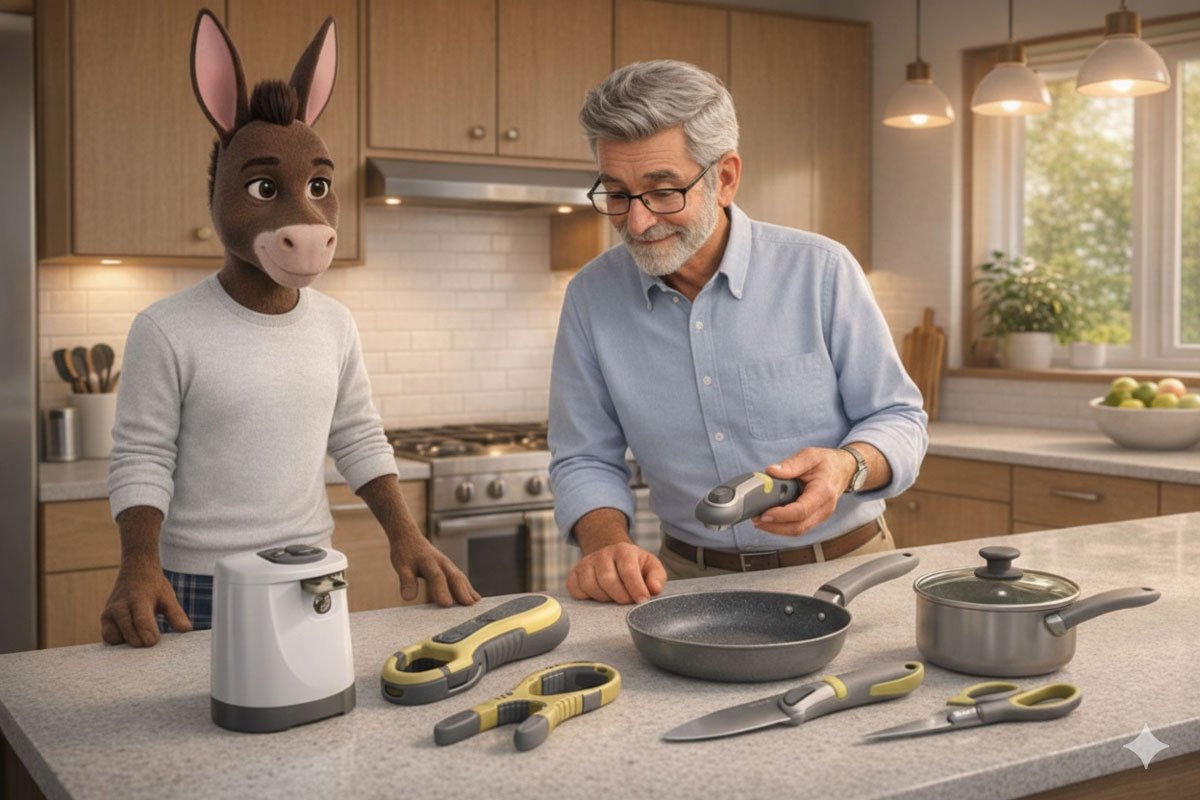
Gregory knows a thing or two about hands that don’t cooperate the way they used to.
Maybe it’s arthritis. Maybe it’s carpal tunnel. Maybe it’s just the quiet wear that comes with decades of chopping, stirring, and twisting jar lids that were sealed by someone who clearly hated everyone. Whatever the cause, the result is the same: your hands hurt, and the kitchen has become a minefield of small humiliations.
A pickle jar you can’t open. A can opener that requires two hands and a prayer. A vegetable peeler that leaves your thumb aching for an hour afterward. These aren’t dramatic problems, but they add up. And when something as basic as making lunch becomes painful, it stops being worth the effort.
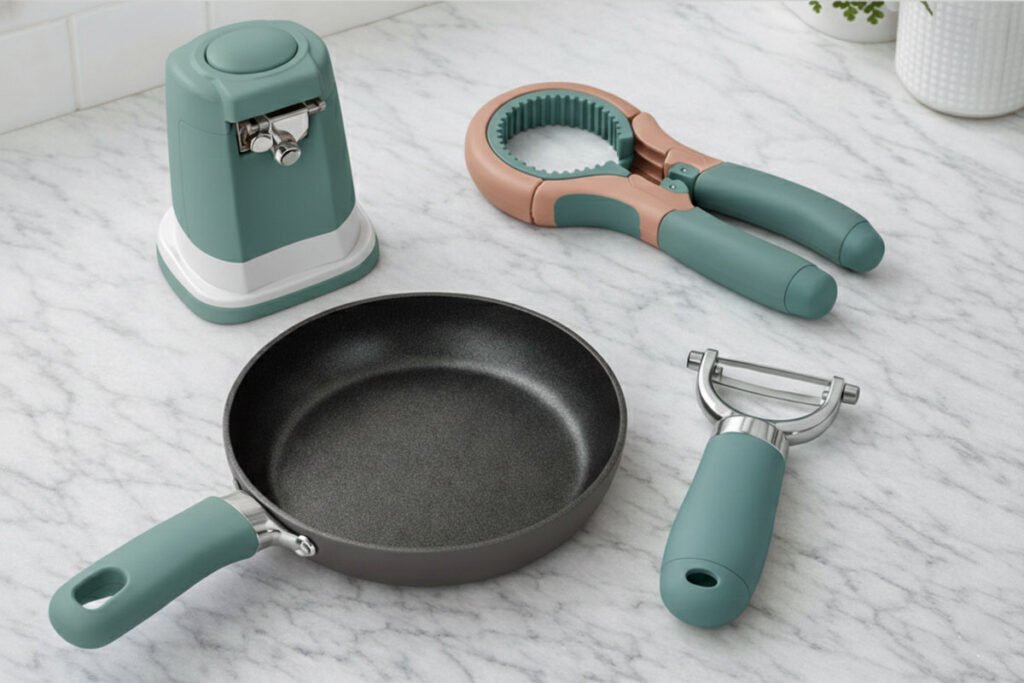
That’s where arthritis-friendly kitchen tools come in. These aren’t gimmicks or “as seen on TV” gadgets that break after three uses. They’re thoughtfully designed tools that actually reduce the strain on painful hands without making you feel like you’re using baby gear.
Gregory believes in buying things that solve real problems. These tools do exactly that.
This website contains affiliate links. As an Amazon Associate, I earn from qualifying purchases. The content on this website was created with the help of AI.
Most kitchen tools weren’t designed with arthritis in mind. They were designed for speed, for efficiency, for people whose hands still do what they’re told without complaint.
The problem is grip strength. Or rather, the lack of it.
When you have arthritis, your hands lose two critical things: strength and dexterity. Narrow handles require more force to grip. Smooth surfaces slip. Heavy pots demand wrist stability you no longer have. And repetitive twisting motions, like opening jars or using manual can openers, can turn a simple task into something genuinely painful.
Arthritis-friendly kitchen tools address these issues by:
These aren’t luxury upgrades. They’re practical solutions to a problem that makes everyday life harder than it needs to be.
Manual can openers are torture devices disguised as kitchen tools. Gregory is convinced of this.
An electric can opener eliminates the twisting, gripping, and squeezing entirely. You press a button. The can opens. Done. Some models are fully automatic and hands-free, meaning you can literally place the can under the blade and walk away.
Look for models with a magnetic lid holder so you don’t have to fish a sharp metal disc out of your soup. One-touch operation is ideal. Bonus points if it’s cordless so you’re not wrestling with a plug every time.
Best for: Anyone who dreads opening cans or has significant hand pain.
Jar lids are designed by people who have never experienced joint pain. Gregory is also convinced of this.
A good jar opener uses leverage instead of grip strength. The best ones clamp under a cabinet or mount to a wall, so you’re using your whole arm to twist instead of relying on your hands alone. Handheld versions with rubberized grips work too, but the mounted ones are genuinely life-changing if you open jars regularly.
Some jar openers are multi-size and adjust to fit everything from pickle jars to medicine bottles. Gregory appreciates tools that do more than one job.
Best for: Anyone who’s ever had to ask someone else to open a jar or just gave up and ate something else.
Peeling vegetables shouldn’t leave your hand throbbing, but standard peelers with thin metal handles do exactly that.
An ergonomic peeler has a thick, cushioned handle that fits comfortably in your palm. The blade should be sharp enough that you don’t have to press hard to get through the skin. Some models feature a vertical orientation rather than the traditional horizontal design, reducing wrist strain.
Look for peelers with soft, non-slip grips and a blade that swivels to follow the vegetable’s shape. Stainless steel blades stay sharper longer, requiring less force over time.
Best for: People who cook regularly and want to keep prepping their own food without pain.
Cast iron is wonderful until you have to lift it. Then it’s a wrist injury waiting to happen.
Lightweight cookware made from hard-anodized aluminum or ceramic is easier to handle without sacrificing cooking performance. Nonstick surfaces mean less scrubbing afterward, which is another win for painful hands.
Choose pots and pans with large, heat-resistant handles that are easy to grip. Some brands make handles specifically designed for arthritis, with wider grips and ergonomic angles. Avoid cookware with narrow, smooth handles that require a tight grip to control.
Best for: Anyone who cooks multiple meals a week and needs to reduce strain on wrists and hands.
A dull knife is dangerous. But a sharp knife with a terrible handle isn’t much better if gripping it causes pain.
Ergonomic kitchen knives have handles designed to fit naturally in your hand with minimal grip pressure. Look for knives with a contoured, cushioned handle and a balanced weight distribution so the blade does the work, not your wrist.
Some arthritis-friendly knives have angled handles that keep your wrist in a neutral position while cutting. This reduces strain on the joints and makes repetitive chopping less painful.
Best for: People who still want to cook from scratch but need tools that don’t punish their hands.
Sometimes the problem isn’t the tool. It’s the lack of grip strength to hold it.
Silicone grip aids are simple rubber discs or pads that increase friction between your hand and whatever you’re trying to open or hold. They work on jar lids, bottle caps, utensil handles, and more.
They’re inexpensive, reusable, and dishwasher-safe. Gregory considers them a low-risk, high-reward purchase. If they help, great. If they don’t, you’re out a few dollars.
Best for: People who want an affordable, multipurpose solution before investing in specialized tools.
| Feature | Standard Kitchen Tools | Arthritis-Friendly Kitchen Tools |
|---|---|---|
| Grip Width | Narrow, requires tight grip | Wide, cushioned handles |
| Force Required | High (manual twisting/squeezing) | Low (leverage or electric assistance) |
| Weight | Often heavy (cast iron, thick steel) | Lightweight materials (aluminum, ceramic) |
| Handle Design | Smooth, cylindrical | Ergonomic, contoured, non-slip |
| Ease of Use | Requires full hand strength | Designed for reduced dexterity |
| Price | $5–$30 per tool | $10–$50 per tool |
You don’t need to replace everything at once. Gregory recommends starting with the tools that cause you the most frustration.
If you open cans regularly, get an electric can opener. If jars are your nemesis, invest in a good jar opener. If cooking dinner leaves your hands aching, upgrade to lightweight cookware. Build your arsenal one tool at a time based on what actually improves your daily life.
Arthritis-friendly kitchen tools aren’t about giving up. They’re about staying in the kitchen longer, with less pain, and keeping the independence that comes with cooking your own meals.
Gregory has watched too many people stop cooking because their hands couldn’t keep up. That’s not a lack of ability. That’s a lack of the right tools.
Arthritis-friendly kitchen tools exist because someone finally recognized that kitchens should be usable for everyone, not just people with perfect grip strength. These tools aren’t luxuries. They’re solutions to real, daily frustrations.
Start small. Pick one tool that will make the biggest difference in your routine. Try it. If it works, add another. Your hands will thank you.
And if anyone tries to make you feel silly for using an electric can opener or a jar gripper, Gregory suggests you remind them that smart people solve problems rather than suffer through them.
Shop arthritis-friendly kitchen tools on Amazon
For more information on managing arthritis symptoms, visit the Arthritis Foundation’s guide to joint protection techniques.